Balcony Vegetable Suitability Checker
Recommended Vegetables
Avoid These
If you’ve ever tried growing vegetables on a balcony, you know it’s not just about sticking a seed in a pot and waiting. Some veggies just don’t play nice with limited space, shallow soil, or hot, windy conditions. You might have seen those perfect Instagram photos of balcony tomato vines spilling over the edge-what they don’t show you are the failed attempts, the stunted plants, and the days you swore off gardening forever. Some vegetables are simply not made for balconies. Here are the ones that consistently beat even experienced urban gardeners-and why they’re so stubborn.
Broccoli and Cauliflower
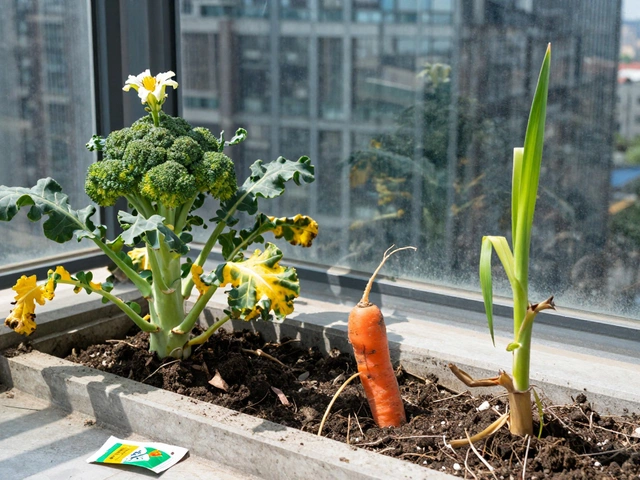
Broccoli and cauliflower look simple enough: plant, water, harvest. But they’re picky. They need cool, stable temperatures between 60°F and 70°F to form tight heads. On a balcony, the sun bounces off concrete and glass, turning the space into a mini heat trap. A few days over 75°F, and your broccoli bolts-flowers out instead of forming heads. Cauliflower is even worse. It’s so sensitive to stress that even a short dry spell or sudden temperature swing can cause buttoning-tiny, useless heads no bigger than a golf ball. You need consistent moisture, rich soil, and perfect timing. Most balcony gardeners plant them too late or too early, and then wonder why nothing looks like the seed packet.
Carrots
Carrots are the silent killers of balcony gardens. They don’t need much space above ground, but they demand deep, loose, rock-free soil. A standard 12-inch pot? Too shallow. Even 14 inches isn’t enough for long varieties like ‘Nantes’ or ‘Danvers’. If the soil is compacted, clay-heavy, or full of pebbles, your carrots split, fork, or grow into twisted, ugly shapes. You can’t fix this by adding compost on top-you need to start with the right mix: 50% potting soil, 30% compost, 20% coarse sand. And you have to keep it evenly moist. Dry spells make carrots woody. Too much water makes them rot. Most people give up after the first harvest looks like a science experiment gone wrong.
Asparagus
Asparagus is a 10-year commitment. You plant crowns, wait two years before harvesting, and then get maybe 6-8 weeks of spears per year. On a balcony? It’s a nightmare. Asparagus roots spread up to 4 feet wide and go down 6 feet deep. No balcony container-even the biggest ones-can handle that. Even if you somehow fit it, the weight of the soil and root system can crack planters or overload railings. Plus, asparagus needs full sun year-round and protection from winter freezes. Balconies get shaded by buildings, and wind chills can kill young spears. You’ll spend three seasons nurturing a plant that gives you two handfuls of spears. It’s not worth the risk unless you have a rooftop with real ground access.
Corn
Corn is a joke on balconies. You see those tall, golden stalks in fields and think, ‘I can do that.’ But corn needs to be planted in blocks, not rows, for proper wind pollination. A single plant or two in pots won’t produce a single ear. You need at least 16 plants in a square formation. That’s 16 large containers-each 12-18 inches deep and wide. That’s 16 heavy pots on your balcony, blocking light, airflow, and walkways. Corn also needs constant nitrogen and deep watering. A 6-foot-tall plant in a pot? It becomes a wind sail. One gust, and it snaps. Even if you manage to pollinate it, the ears are small, sparse, and underdeveloped. Save corn for the backyard. On a balcony, it’s just a tall, thirsty disappointment.

Winter Squash (Butternut, Acorn, Kabocha)
Winter squash vines can stretch 10-15 feet. They need wide-open space, rich soil, and lots of sun. On a balcony? You’re fighting gravity. You can train them up trellises, but the fruit gets heavy. A single butternut squash can weigh 4-6 pounds. That’s more than most balcony railings are designed to hold. If the vine slips or the trellis gives way, you’re left with smashed squash and a broken planter. Even if you support the fruit with slings, the plants need consistent warmth and moisture. A cool night or dry spell causes blossom drop. And you can’t just pick one squash-you need to grow at least two or three to get good pollination. It’s a lot of work for a few veggies that store for months anyway. You’re better off buying them.
Potatoes
Potatoes seem easy-just toss a seed potato in a bag and wait. But growing them on a balcony is trickier than it looks. You need deep containers-minimum 18 inches-and you have to keep adding soil as the plants grow (a process called ‘hilling’). Most balcony gardeners use grow bags or buckets that are too shallow. The result? Small, misshapen tubers or none at all. Potatoes also need cool roots and warm tops. Balconies get hot in the afternoon, baking the soil. You need to shade the pots or use light-colored containers. And you can’t overwater-they rot. Underwater? They shrivel. You also need to rotate crops. Growing potatoes in the same soil year after year invites blight. Most people get a decent harvest the first year, then wonder why the next season yields nothing.
Why These Vegetables Fail on Balconies
It’s not just about space. It’s about microclimate. Balconies are extreme environments. They get full sun, wind, reflected heat, and poor air circulation. Most vegetables evolved to grow in stable, open fields-not on a 10th-floor ledge. The plants that succeed on balconies-like peppers, cherry tomatoes, lettuce, and herbs-have shallow roots, fast growth cycles, and tolerance for temperature swings. The ones that fail? They need deep soil, steady temps, room to spread, or perfect pollination conditions. You can force them, sure. But you’ll spend more time fighting nature than enjoying the harvest.

What to Grow Instead
Stick to vegetables that thrive in containers and tolerate urban conditions:
- Cherry tomatoes - Compact varieties like ‘Tumbling Tom’ or ‘Balcony Cherry’
- Peppers - ‘Carmen’ or ‘Jalapeño’ do great in pots
- Green beans - Bush types like ‘Provider’ don’t need trellises
- Lettuce and spinach - Fast-growing, shallow-rooted, perfect for window boxes
- Radishes - Ready in 3-4 weeks, even in 6-inch pots
- Herbs - Basil, thyme, rosemary, and mint all do well
These plants give you reliable yields with minimal fuss. They don’t need deep soil, perfect pollination, or perfect weather. They adapt. That’s what urban gardening is really about-working with your space, not against it.
When You Should Still Try the Hard Ones
There’s one exception: if you have a large, south-facing balcony with no overhead obstructions and you’re willing to invest in deep planters (24+ inches), drip irrigation, and shade cloth, you might get away with one or two broccoli plants or a single carrot bed. But don’t expect perfection. Treat them like experiments. Keep notes. Adjust. If you get one decent head of cauliflower? Celebrate it. That’s urban gardening-small wins, big lessons.
Final Tip: Start Simple
Don’t begin with the hardest vegetables. Start with lettuce, radishes, or cherry tomatoes. Learn your balcony’s sun pattern. See where the wind hits. Test your soil drainage. Get a feel for watering needs. Once you’ve got a rhythm, then you can try the tougher crops. Most failures aren’t because the gardener is bad-they’re because they skipped the learning curve. Patience beats ambition every time on a balcony.
Can you grow broccoli on a balcony at all?
Yes, but only with careful planning. Use deep pots (at least 18 inches), keep the soil consistently moist, and choose early-maturing varieties like ‘Waltham 29’. Plant in early spring or late summer to avoid summer heat. Use shade cloth if temperatures rise above 75°F. Even then, success isn’t guaranteed-expect small heads or bolting.
Why do carrots grow so weird in pots?
Carrots need loose, deep, stone-free soil to grow straight. Most potting mixes are too compact or contain too much peat. Use a custom mix: 50% potting soil, 30% compost, 20% coarse sand. Fill pots at least 14 inches deep. Avoid over-fertilizing-too much nitrogen causes forked roots. Keep soil moist but not soggy.
Is it possible to grow corn on a balcony?
Technically yes, but practically no. Corn needs to be planted in blocks of at least 16 plants for pollination. Each plant needs a 12-inch pot. That’s 16 heavy containers on your balcony, blocking light and airflow. Even then, ears are small and poorly filled. Wind on balconies doesn’t help pollination. It’s far easier to buy corn.
What’s the deepest planter I should use for root vegetables?
For carrots, parsnips, or potatoes, use planters that are at least 18 inches deep. For asparagus or large squash, you’d need 24+ inches-which is rarely practical on balconies. If your planter is less than 12 inches deep, stick to shallow-rooted crops like lettuce, spinach, radishes, and herbs.
Can I grow asparagus in a large container?
It’s not recommended. Asparagus roots spread 4 feet wide and go 6 feet deep. Even the largest balcony containers (24x24 inches) can’t accommodate that. The plant will become root-bound, produce weak spears, and die within 3-4 years. It’s better suited for ground planting. Save your balcony for annuals and shallow-rooted perennials.